Thursday, 10 December 2020

Day Four


Although some of the American YouTube videos demonstrate how to support the neck joint during glueing using folded paper wedged between the G-clamps and the fretboard and back of the guitar, I thought that was somewhat slipshod. It seemed logical to me to protect the newly-dressed fretboard and carefully rubbed-down body with more than a few folds of Xerox copier and emulated the idea shown in one of Coban’s videos and made a pressure board with slots for the frets. This meant the pressure bore directly and solely on the ebony not on to the fretwire. Protecting the back with a flat piece from the same offcut was simple.


I planned to use some Gorilla brand wood glue I had on the shelf but it was rather solid and heavy. Rather than spoil the job for £4 worth of fresh glue, I added a few pounds more to the overall budget. I checked the joint without glue to decide where best to position the two g-clamps. It’s a job that ideally needs three hands but since the good lady of the house was not available I managed with just my two. My sense is that there’ll be a small clean-up job when the clamps are removed but, no big problem.


I was pleased when the luthier complimented me on the smoothness of the neck but the real test will come when we can check the fitting with strings. I plan to let the parts supported under pressure settle firmly before disturbing the joint sometime late tomorrow. 

Wednesday, 9 December 2020

Day Three

Before I start the poly coating process I’ve decided to have the fretboard levelled and dressed professionally. On my kit, it’s the single most necessary job to be done and the one that really does need both specialised tools and skill. I’ve been quoted £40 by the luthier at PMT in Manchester for a job he’ll complete in about an hour. Unfortunately due to the present health restrictions, I can’t watch him but even so, the charge compares very favourably with the cost of the tools for me to do the job myself, even if I ignore the company that rather arrogantly places itself and its equipment higher than all the other UK suppliers

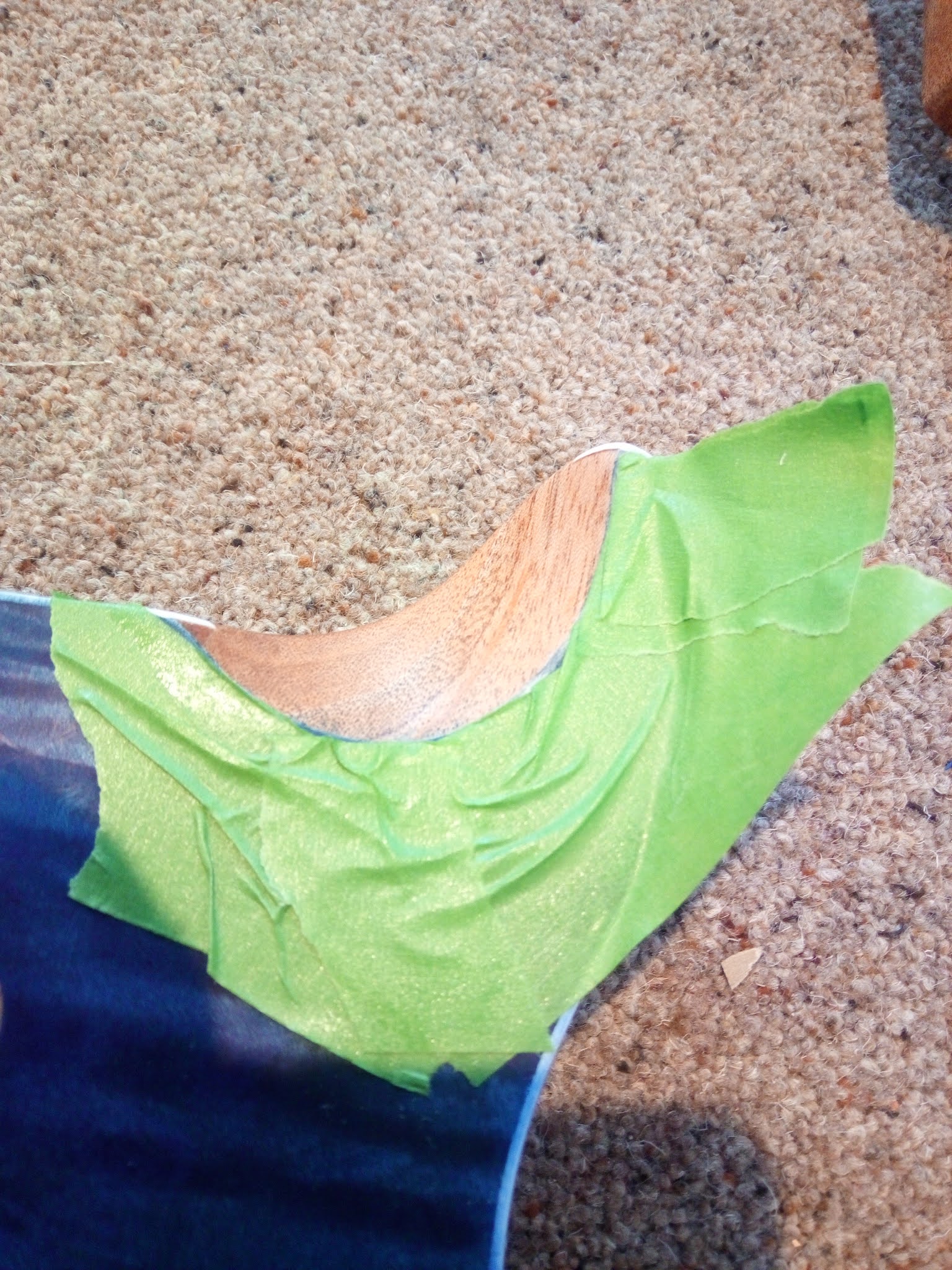
The other detail I’ve discovered applies to this particular kit. That’s the very attractive deep scoop on the treble cutaway, a feature of PRS guitars. With Coban’s veneer top it’s difficult to mask the scoop to avoid getting the stain one uses on the veneer from the scoop – assuming one is going to treat the scoop in the same way as the back and sides – in my case as unstained wood. If I make another instrument with this design I’ll avoid a veneered top and treat the top, scoop, sides and back in the same fashion. I think it’s going to end up as a fine-pointed paint-brush job along the edge of the veneer.


Monday, 7 December 2020

Day Two

One of the themes running through the YouTube videos concerned with building a kit guitar is a mantra that seems to say ‘guitar necks should be as natural and untreated (ie unvarnished) as possible’. Yet when I look at my professional modern guitars, Gretsch and Gibson, at my grandson’s Epiphone, they all appear to have the same glossy finish on the neck as well as the body. I can understand it might be ideal to have only a light coating of polyurethane but at the end of the day, most professional makers seem to put durability above ‘feel’ or ‘sensation’.

So, today I purchased a tin of glossy polyurethane varnish and a large supply of white spirit intending to emulate a private maker whose guitar simply dazzles in his YouTube video - much as the genuine PRS guitars mine is based upon shine.

The man whose advice I’m taking gave his instrument five or six coats of very dilute varnish – he estimated a 4 to 1 mixture, each coat allowed to dry for 24 hours and rubbed down with 600 grit wet and dry before the next. Finally, he gave it two coats of a stronger mixture of the same ratio but with the ingredients reversed, ie 4 parts varnish, 1 part white spirit.


Day One

The first job is the preparation of the neck and the body. I bought four packs of wet and dry from Tool Station each containing 10 sheets in 180, 400, 600 and 1200 grit. I already had a sanding block so the total cost there was about £10. Four hours later I was happy that I’d smoothed the body and the neck to a more than adequate finish. There’s no rocket science involved, just elbow grease. By the occasional use of a damp cloth to raise the grain, the dust raised was minimal and earned no hostile comment from my wife. I used the small veneer off-cut (a bonus included by UK Music Supplies with kits sold directly) to test the stain but, as I'll explain in a moment, ultimately I was sorry I’d bothered with the black. Multiple coats of the blue would have created the effect I wanted and I’d have saved £5.


One thing I did copy from the videos was to insert a short-shanked screw hook in the place where the bottom strap button will go. When you come to staining and other body treatments it’s a great help. On the same subject, I took careful note of a comment by the luthier with the unusual skull tattoos who recommended very long screws for the strap buttons; evidently, he’s seen more than a few accidents caused by buttons coming loose on stage.

Another purchase I’d strongly recommend is some painter’s masking tape (£5 from Screwfix). Masking off places like the distinctive shoulder carving of the PRS model is vital.

In the end, I gave the veneered front of the body eight coats of stain. Many of the first were diluted and rubbed back when dry, but later ones were full strength.

I’d decided to use the Penetrating Guitar Oil on the sides and back of the body and the neck and headstock. I gave the parts two coats and rubbed down with 600 and 1200 grit paper when each was dry and rested overnight. 


One final point. During the sanding of the neck I must have nudged the nut which fell off. A YouTube video I watched showed a guitar tech fixing a nut back on a guitar. He used just a small blob of super glue to hold the nut in position then restrung the guitar. This allowed the pressure of the strings to fasten the nut in position.

The reason he used just a small amount of super glue was to avoid damaging the neck or fretboard if a subsequent repair needed the nut removal.

My purchase


Anyway, let’s get to my own purchase. I bought a PRS-style guitar. The carrier had managed to punch two holes in the box that reached right through to the contents; fortunately, they were undamaged but more care with the packaging wouldn’t go amiss.


Because I’d commented on the ill-fitting of a Coban neck and body demonstrated on one of their videos, UK Music Supplies offered to check the fitting of the instrument they were sending me – another benefit. The rest of the supplied kit was correct. Other companies are very sniffy about the ‘standard Chinese-quality machine heads’ supplied in less-expensive kits. I’m not qualified to comment but the units are sealed, feel as though they’re at least adequately lubricated and, let’s face it, the gearing is one of the most basic known to engineering. I sense there’s more than a little ‘brand-awareness’ arrogance going on here.


The biggest potential drawback of a cheap kit is excess glue, especially on any veneered surface. The glue won’t take the tints or other treatments applied to the surface but can’t be seen until the first coat is applied. The grandson who would like to own the instrument I’m building expressed a wish for a blue guitar and so I bought bottles of Royal Blue and Black stain from the best-advertised guitar stain company. The company's video claims the black will bring out the effect of the flame effect in the veneer, blue will provide the main colour of the front of the guitar body. On the evidence of my instrument, I disagree. 

The back of the body and neck will be in uncoloured wood. Along with a 150ml can of oil for the neck from one of the most expensive luthier companies, including an extortionate £6 for delivery of a modest Jiffy bag the cost was about £20. 

If I'm tempted to make another guitar, I will follow the advice of another video and use bulk supplies of inkjet printing ink. Quite obviously it does as good a job as the expensive stain.  

Other choices and considerations

The Coban kit’s instructions consist of two densely typed pages of A4 and a wiring picture, not an electrical diagram. The paucity of instructions is readily acknowledged by the company and the buyer is urged to explore and learn from the many kit guitar building websites and YouTube videos. Hmm. That’s my reaction based on more than 30 years experience of making television and video programmes. 

Like the majority of YouTube videos, most of those about building guitars are not professionally made. There’s rarely any evidence of a script. Production values are virtually nil. In more than one video the demonstration stops and is replaced by a title apologising that the camera battery ran out before the critical stage was recorded. The sound levels are very variable, a characteristic often made worse by unnecessary and unnecessarily loud guitar music. The images are often out of focus and editing is rarely polished. All of this means the videos are sometimes hard work to watch. More than once my heart sank when I saw that a video lasted more than 60 minutes and still only covered a small part of the guitar-building process.

Ironically it’s not just the home-grown videos that are low on production values. One of the best-known kit guitar company’s videos is fronted by a luthier who evidently believes he is a stand-up comedian. You can tell he’s a luthier because, like all those claiming to be qualified, he stands in front of the world’s supply of tools. Luthier he may be; comedian he’s not. Sadly his attempt at humour is rambling and laboured which only reduces the value of his videos even more.

So what help is the internet?

Frankly not much. For a start it's inconsistent. For example, Coban recommends preparation of the guitar body with up to 2000 grit wet and dry; the famous luthiering company with its putative comic recommends a maximum of only 240 grit. Take your pick, they can't both be right. 

For every YouTube video recommending an oil, urethane or water-based treatment for the wood there’s another declaring that product to be useless. Add to that, big differences in the market; for example, Tru Oil is a staple of the gun-owning fraternity in the USA who use it to maintain the wooden stocks of their guns. In the UK it’s as difficult to locate as the guns it’s made for. Other treatments require annual or bi-annual work to maintain their looks and efficiency – hardly practical for a youngster’s instrument. 

On my evidence, the quality of the management of the companies in the market is very variable. My guitar was supplied with holes drilled for an Adjustomatic-type bridge and a stop tailpiece. Yet the hardware supplied was a Stratocaster-type, combined bridge and tailpiece and a tremolo unit accessed from the back of the guitar. 

In fairness, another measure of the quality of a company’s management is the manner and urgency with which they endeavour to correct mistakes. On that basis, UK Music Suppliers/Coban can’t be faulted. I reported the flawed packaging on a Saturday, the replacement hardware was despatched at once.

Finally, before getting down the actual build, the one element that needs serious attention by the builder is the fretboard. To say the frets need attention is an understatement. The frets shredded the wet and dry I used to smooth the neck and some of the frets are clearly lower than the others. The solution isn't one of ability or experience though clearly fret dressing requires the proper gear. I've always held that cheap tools are a poor investment but even middle-range luthier kit isn't cheap. It's specialist equipment and has to be regarded as an investment.

The trouble is if you're only envisaging building one or two guitars, you'll never see a return on that investment. The solution is to pay a luthier to do the work for you - a suggestion that's easier to write than to achieve during lockdown but which is obviously the solution. Happily, it doesn't prevent you from getting on with other parts of the build.


First things first...

I chose to make a kit principally because I don't have the woodworking skills to start from scratch nor do I have the equipment that's necessary to commence with a block of wood.

I selected the kit to buy and build quite carefully. I decided to build a sold guitar, partly because it demands fewer woodworking skills than a hollow-bodied instrument or an acoustic model. I also learnt that some forms of rosewood can cause irritation if inhaled and although I’m fairly fit for my age I didn’t want to risk my health. That's why I chose a guitar with a mahogany body and neck with a thin veneer of maple glued to the top of the body.

Avoiding the potentially 'harmful' timber meant the very least expensive kits were out of contention. The fact that my budget was limited also ruled out the more expensive and better-known ‘name’ brands. In any case, the last category of kits are not only very expensive but they’re not even complete kits which meant my inexperience might end up costing me much more than my budget would allow. Another factor was that I’d written to one of the ‘posh’ companies, well-known for their luthier's supplies, asking about their in-house week-long courses but they didn’t even bother to reply.

Ultimately I chose a Coban brand kit, imported from China by UK Music Supplies in Norfolk. They’re also available on Amazon but the direct price is a few pounds less and you get a little more for your money.

Day 12 Plus

 Day Twelve Plus Following some advice I received on an internet group of guitar builders, I’ve given the body – front, back and sides – thr...